


Options for Landlords Ready to Exit a Rental Property

Extended Openroom Network
Explore practical options for Ontario landlords exiting rental properties, including tenant-in-place sales, repairs, taxes, holding costs, and direct sales.
Read More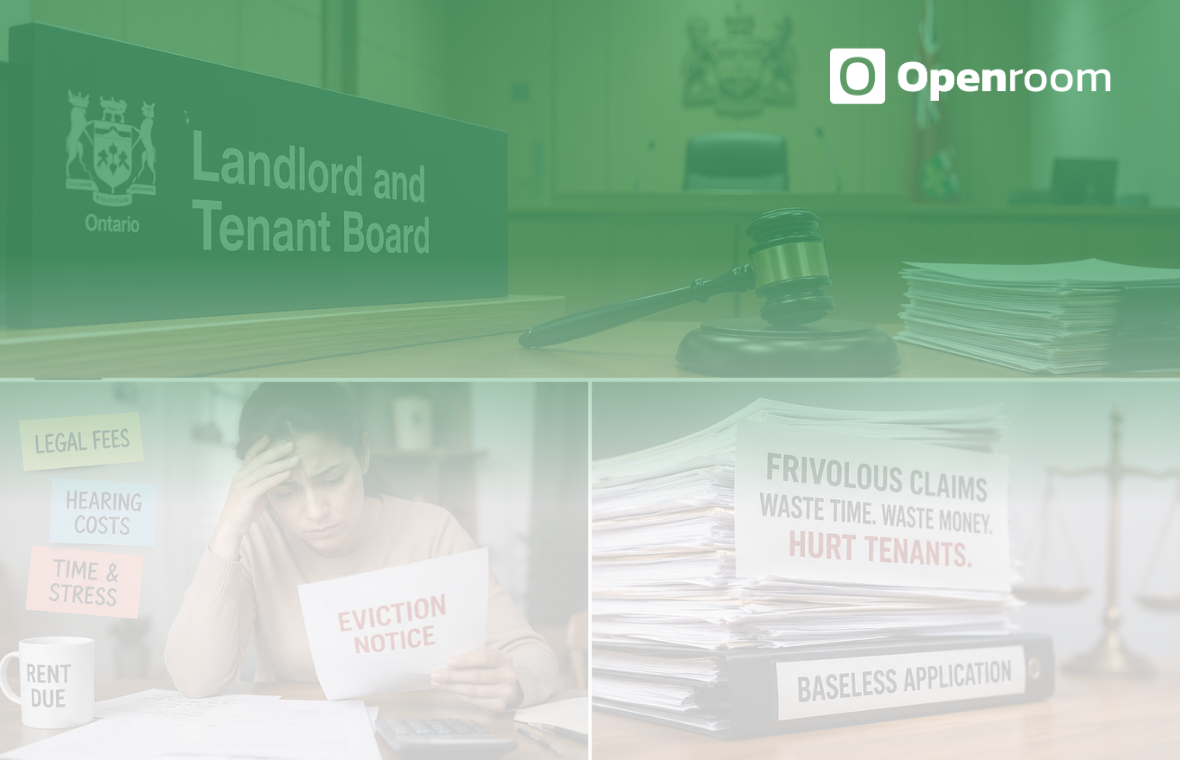
Prevailing at the Ontario Landlord and Tenant Board (LTB) or Divisional Court often results in a pyrrhic victory because parties will never meaningfully recover their legal costs.
We’ve previously written about how corporate landlords often file nonsense applications against tenants. Those landlords’ representatives then refuse to recognize they’ve filed nonsense applications when we point out their defects, refuse to discuss resolution of the alleged issues in their nonsense applications, and then they lose those nonsense applications.
But the tenants involved are still left with a massive legal bill for all the work that went into getting their landlord’s garbage application dismissed. That’s because the LTB's Rules of Practice cap legal cost awards at $700 per hearing. Though even that number is somewhat meaningless, since the LTB barely ever awards any costs at all.
As CBC correctly noted in their article on the subject, this is a systemic problem which the government has taken no steps whatsoever to rectify. It’s also a tactic deep-pocketed corporate landlords apparently use to exhaust tenants into vacating their units.
In British Columbia (Minister of Forests) v Okanagan Indian Band, the Supreme Court of Canada confirmed that cost awards function not only to compensate the successful party, but to discourage weak or unsupported claims, encourage settlement, and promote the efficient administration of justice.
At the tribunal level in Ontario, that function is outrageously diluted. A party advancing frivolous claims bares little risk of meaningful financial consequences. As a result, not only have we seen corporate landlords filing baseless applications to exhaust tenants, but we’ve also seen tenants filing baseless applications against landlords for the express purpose of wasting their time and money.
While the LTB provides a stark example of the problem, most administrative tribunals in Ontario likewise operate under a highly discretionary cost regime governed by section 17.1 of the Statutory Powers Procedure Act (“SPPA”). The SPPA directs tribunals not to award costs unless a party’s conduct is found to be unreasonable, frivolous, vexatious, or in bad faith.
In practice, even if that threshold is met, cost awards remain highly exceptional, reflecting a strong institutional preference for accessibility and ensuring aggrieved parties can file claims without worrying much about the consequence of losing. But accessibility cuts both ways. Where claims can be easily initiated, there must also be meaningful consequences for advancing them irresponsibly.
Exacerbating the issue, Ontario’s corporate landlords often hire low-cost paralegals who operate on a volume-driven litigation model with little client supervision. Eviction applications are filed quickly and easily. Hearing attendance is billed to the client and carries limited downside risk. There is no incentive for the paralegal to narrow issues or pursue settlement, as the client isn’t paying attention and it’s more profitable to proceed full steam ahead, even if the application will immediately be dismissed once an adjudicator looks at it.
Operating like this is prohibited by the paralegal Rules of Conduct, but the Law Society of Ontario is highly reticent to discipline practitioners unless there’s a $7 million hole in their trust accounting.
The situation respecting Divisional Court appeals of LTB matters is better, but not much.
Paralegals are prohibited from taking on Divisional Court appeals of LTB cases. Appellants either need to hire a lawyer or proceed unrepresented. Though often paralegals will take these cases, operating from behind the scenes. Sometimes they won’t even tell their clients that they’re operating unlawfully.
As a result, it’s not uncommon to see self-represented clients pursuing an appeal with a paralegal assisting in the shadows, or making do with AI and Reddit advice. This likewise results in a massive waste of time and money for the respondent who needs to spend hours dismantling the appellant’s word salad filings.
Divisional Court appeal representation often costs a party something like $20,000. The Divisional Court will typically award costs in the vicinity of $3,000, which is small consolation. And obtaining that award from a losing party may not even be worth the hassle, especially if the underlying issue is they didn’t have money to pay rent to begin with.
To address the issues raised above, our firm recommends that the Ontario Ministry of the Attorney General, in consultation with Tribunals Ontario, implement the following changes:




Marc Z. Goldgrub and Rachael Ostroff-Mann are lawyers at Green Economy Law Professional Corporation, an international boutique corporate law and litigation firm with a focus on green business, psychedelics, and housing.
Their green and psychedelic business law practice handles legal matters including incorporation, contracts, employment, IP, and regulatory compliance.
Their housing-focused litigation practice handles legal matters coming before the Human Rights Tribunal (HRTO), Small Claims Court, Superior Court of Justice, and Divisional Court.


.png)
.png)
.jpg)







.png)
%20(1).png)





.png)


.png)
.png)














.png)


.png)
.png)

.png)


.png)


