


Bill 60: Key LTB Changes Take Effect Today, September 21
.jpg)
Landlord Association
Bill 60 introduces major LTB changes affecting N4 notices, late payments, hearings, own-use terminations, renovations, and eviction enforcement.
Read More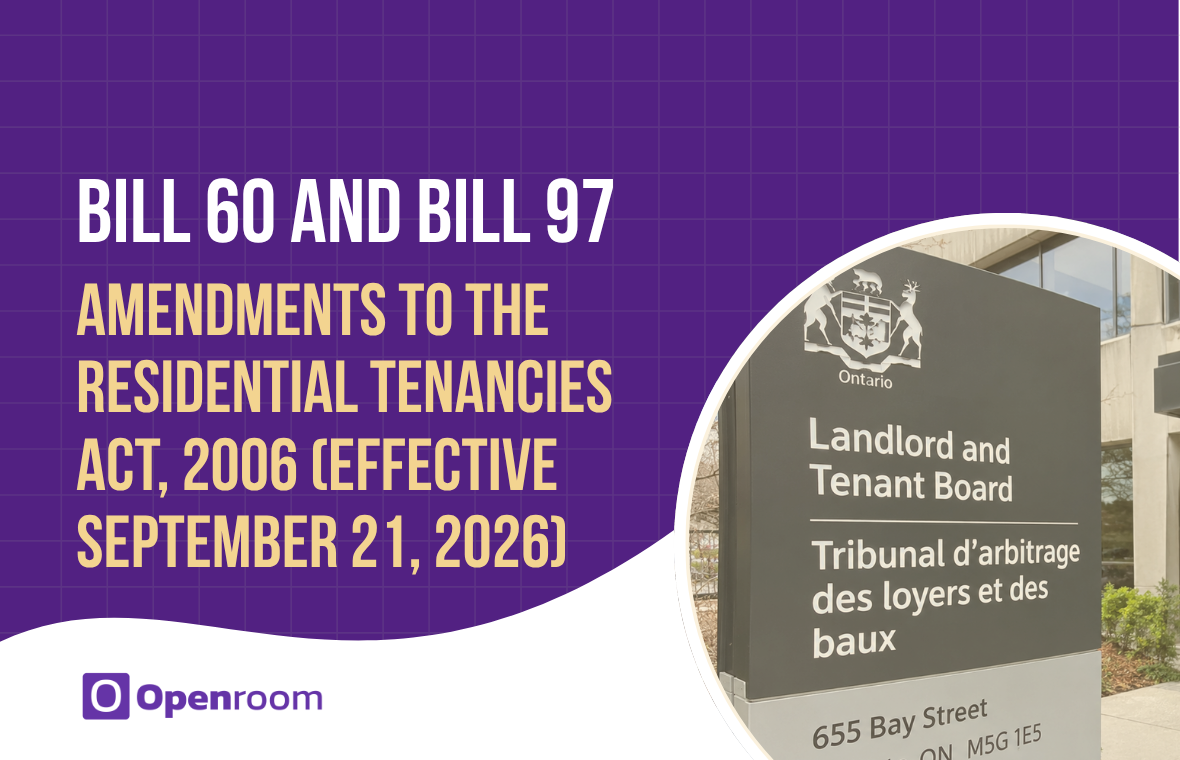
The following was an announcement from Landlord and Tenant Board (LTB). Openroom is doing a repost to our audience.
Read original memo issued by the LTB on September 21, 2026
Further to our memo on July 1, 2026, we are writing to inform you of several additional changes at the Landlord and Tenant Board (LTB) that will come into effect as of September 21, 2026. These changes reflect amendments to the Residential Tenancies Act, 2006 (RTA) introduced through the Fighting Delays, Building Faster Act, 2025 (Bill 60) and the Helping Homebuyers, Protecting Tenants Act, 2023 (Bill 97).
The following changes will take effect today, on September 21, 2026:
For notices served on or after September 21, 2026, if the landlord gives at least 120 days’ notice to end a tenancy for personal use using an N12 Notice, they are no longer required to:
If the landlord provides less than 120 days’ notice, the existing compensation rules will apply. This change does not apply to N12 notices served for purchaser’s own use of the rental unit.
Effective September 21, 2026, the landlord or another specified person (such as an immediate family member or their caregiver) must normally take occupancy within 60 days of the date specified in the N12 Notice to End Tenancy for Landlord’s Own Use.
If the Landlord or intended person does not take occupancy within this time frame, it may be presumed that the notice of termination was given in bad faith. The tenant may file a T5 Application: Landlord Gave Notice of Termination in Bad Faith.
This change does not apply to N12 notices served for a purchaser’s use of the property.
If a landlord files a N13 Notice of Termination to end a tenancy due to renovation and repairs, the tenant has the right has the right to move back into the rental unit once the work is done at a rent that is no more than what the landlord could have charged if there had been no interruption in the tenancy.
If the tenant provides written notice on or after September 21, 2026, that they intend to move back into the rental unit once the work is completed, the landlord must:
The landlord must also provide the tenant with 60 days’ notice to reoccupy the unit following the completion of renovations if the work is completed on or after September 21, 2026.
Under the existing rules, tenants may apply to the LTB using a T5 Application: Landlord Gave Notice of Termination in Bad Faith if they give written notice to their landlord that they want to move back into the rental unit after repairs or renovations are completed, and the landlord did not allow them to move in.
Effective September 21, 2026, the deadline for a tenant to file a T5 Application will change. The new deadline is two years after the date the tenant moves out, or within six months after the renovations are finished, whichever date is later.
Effective September 21, 2026, if a tenant gives written notice to their landlord that they want to move back into the rental unit after repairs or renovations are completed, and the landlord did not provide the required information about when the unit would be ready for occupancy or did not give the tenant 60 days to move in, it is presumed that the landlord failed to give the tenant a right of first refusal. The landlord has an opportunity at the hearing for the T5: Application to prove that the N12 Notice was not served in bad faith.
The notice period for an N4: Notice to End Tenancy Early due to Non-Payment of Rent is shortened from 14 to 7 days. A revised version of the notice form is now available on the Tribunals Ontario Portal and Website.
UPDATED: N4: Notice to End Your Tenancy Early Due to Non-Payment of Rent
In order to raise other issues at a hearing for non-payment of rent (such as maintenance or Tenant’s Rights concerns), the tenant must pay the landlord half of the rent arrears claimed in the landlord’s application at least seven days before the hearing.
This applies if the landlord filed the rent arrears application on or after September 21, 2026.
Payment must be made directly to the landlord. It cannot be paid to the LTB in trust. Tenants should keep a receipt as proof of payment.
The existing requirement that the tenant provide the landlord and the LTB with a description of all the issues they want raise at least seven days before the rent arrears hearing continues to apply.
UPDATED: Issues a Tenant can Raise at a Hearing about a Landlord’s application for Non-Payment of Rent (Form)
As of September 21, 2026, a tenant is considered to have persistently failed to pay rent on the date it becomes due when the rent is received more than seven days after the due date, at least three times within a six-month period.
However, if the only reason the payment is late is the landlord applied the tenant’s rent payment to another amount the tenant owed, such as rent arrears from an earlier period or unpaid utility charges, it is not considered late for this purpose.
A tenant may also be found to have persistently failed to pay their rent on the date it became due in other circumstances.
Effective September 21, 2026, the LTB may grant a tenant's motion to cancel an eviction order that was based on an agreement between a landlord and tenant to end the tenancy, or on a notice given by the tenant to end the tenancy, only if the LTB is satisfied that doing so would not be unfair.
The LTB cannot consider changes in the tenant’s circumstances that occurred after the agreement was made or after the tenant gave notice to end the tenancy.
Effective September 21, 2026, if the hearing is held to consider a landlord's eviction application the LTB may only order that an eviction be delayed if certain conditions are met.
If the landlord agrees, the LTB may delay the eviction.
If the Landlord does not agree, the LTB must be satisfied that:
For notices of termination for landlord or purchaser’s own use and renovation or repairs, the LTB must only be satisfied that a delay would not be unfair to the landlord or other tenants in the residential complex.
The LTB’s Rules of Procedure have been updated to improve clarity and formatting, reflect recent legislative amendments, and align with current practices.
UPDATED: LTB’s Rules of Procedure
Effective September 21, 2026, the following forms have been updated and replaced on the Tribunals Ontario Portal and website. The old version of these forms will no longer be accepted as of November 30, 2026.
All updated rules, forms, instructions, and brochures are available on the Tribunals Ontario Portal and the Tribunals Ontario website.
We encourage you to review your current processes and make any necessary adjustments to ensure compliance with these new rules, processes and timelines.
.png)



Weiting's entrepreneurial journey began with a costly lesson in rental property management, where she experienced losses exceeding $35,000 due to non-paying tenants. Determined to prevent others from facing similar challenges, she built Openroom to pave a future towards a transparent and connected rental ecosystem.
Drawing from her extensive background in software product management spanning education, telecommunications, insurance, and artificial intelligence, Weiting has become a trusted advisor to founders of venture-backed companies. Beyond the tech sphere, Weiting managed properties for over a decade and made significant contributions to community leadership. She’s served on the Board of Rotary District 7070 and chaired various organizational committees.
Weiting balances her professional endeavours with being a parent of two kids under two. Alongside thousands of other parents, she was awarded participation trophies in innovative improvisation, ever-changing expectations management, daily roadmap planning, and hardcore patience!
.png)










.png)
%20(1).png)





.png)


.png)
.png)














.png)


.png)
.png)

.png)


.png)


