Where are LTB orders filed in Ontario? Based on the 2026, Openroom.ca has data maps 40,844 orders across 485 neighbourhoods. See the top postal codes and search your own area to find out where your area stands.
KEY TAKEAWAYS
The January to May 2026 release covers 40,844 LTB orders across 485 neighbourhoods.
85% of cases were filed by landlords, and about 51% involve unpaid rent.
Raw counts follow the population in that geographical postal code, so Openroom also measures cases per 1,000 renter households to show the true intensity.
You can search your own postal code for free on Openroom’s analysis page.
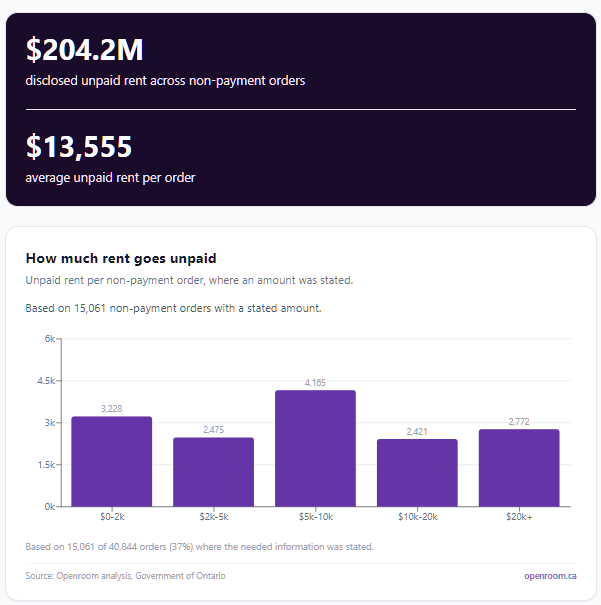
Ontario’s new release maps 40,844 Landlord and Tenant Board (LTB) orders from January to May 2026 across 485 neighbourhoods. Toronto and the GTA lead in raw numbers, but unpaid rent cases show up in communities all over the province. Together, the orders disclose $204.2 million owing.
When the Government of Ontario released its 2026 court orders, the first thing everyone asked me was the same question. “Where are all these cases coming from?”
Such a great question.
So, naturally I had to ask my team for help. They blew me away by mapping every single one.
That’s right, we mapped all 40,844 orders and sorted the data into 485 neighbourhoods by postal code.
OK overachievers!
Today, I’m going to be walking you through where Ontario’s rental disputes actually happen. Spoiler: it’s definitely not just downtown Toronto.
What are these orders, real quickly?
The Landlord and Tenant Board (LTB) is the Ontario tribunal (psst, it’s slightly different than a court!) that settles disputes between landlords and tenants under the Residential Tenancies Act (RTA). An order is the board’s written decision.
In this release, about half the orders are L1 applications, which means it was for unpaid rent. Surprise…or not…
The rest included evictions for other causes (L2), broken settlement agreements (L4), and cases which tenants brought about repairs and rights.
The places with the most orders from January to May 2026 are…
Rank
Postal Code
Area
Orders
1
M3N
Toronto
390
2
M6K
Toronto
385
3
M4Y
Toronto
378
4
L8L
Hamilton
328
5
M9V
Toronto
315
6
M9N
Toronto
306
7
L4N
Barrie
303
8
L1J
Oshawa
303
9
M5A
Toronto
296
10
L1G
Oshawa
290
Source: Openroom, Government of Ontario, Statistics Canada (2021 census tenure) openroom.ca
A few things jump out to me when I first read it.
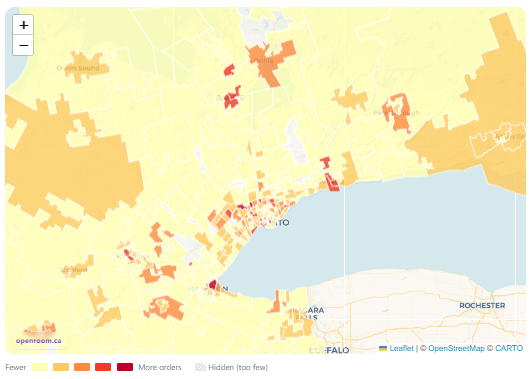
Big numbers gather where big rental buildings may be.
A high count (or deep red colour) doesn’t exactly mean it’s a “bad” neighbourhood. It often just means lots of renters live there.
Is this just a Toronto problem?
No. Toronto leads in the highest case numbers because Toronto has the most renters - naturally that would make sense because it’s the most populated and dense neighbourhood in Ontario.
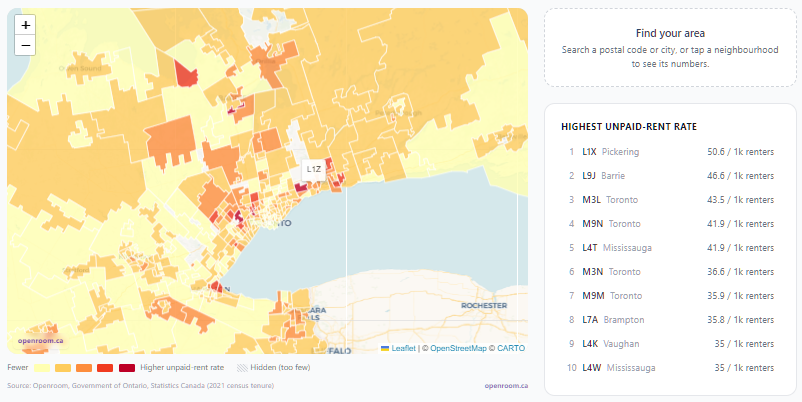
However, when we measure unpaid-rent orders per 1,000 renter households, other cities and towns light up in colours too.
That per-renter view shows where a renter household is most likely to end up in an order.
Source: Openroom, Government of Ontario, Statistics Canada (2021 census tenure) openroom.ca
For landlords: knowing your area’s numbers helps you plan and predict what may happen in the future.
If you own a rental in a high-activity area, screening and paperwork matter even more so don’t be cheap on this.
If f managing the property yourself is getting heavy, a good property manager can carry a lot of that.
Two firms we support: CMG Toronto for the GTA and Rent Panda for landlords across Ontario. Both handle tenant placement and day-to-day management so small landlords don’t lose thousands in rent dollars. It can happen because it happened to me as a small single unit rental owner.
For renters: this is a gentle reminder that LTB orders are eventually all going to be public. Know that before you sign a lease, you can look up a landlord’s history the same way landlords look up tenants.
What about the rest of the report?
The location data is just one piece of the data that we looked at.
The same data we analyzed through showed us that there was $204.2 million in disclosed amounts owing, mostly unpaid rent.
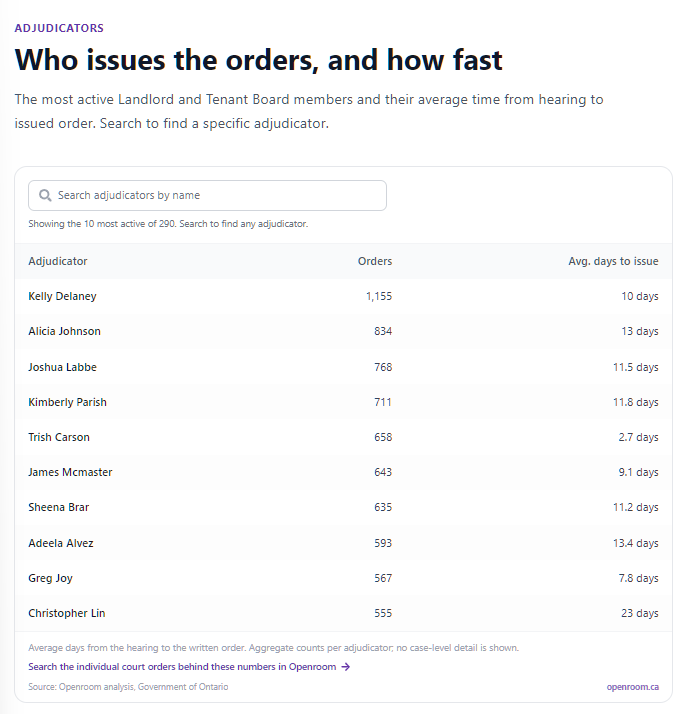
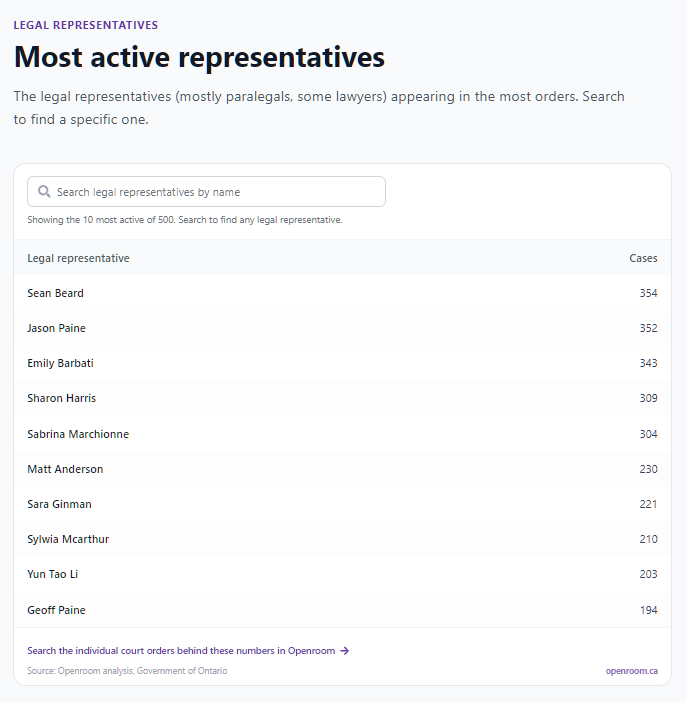
It also names the 285 adjudicators who decided these cases and the 500 legal representatives who appeared in them. The busiest adjudicator issued 1,155 orders in five months - that’s like 11 orders a day that they were pumping out!!!
Source: Openroom.ca chart for legal representatives
Questions people usually ask us
Which city has the most LTB orders in Ontario?
Downtown Toronto has the highest raw count, which makes sense since it has the most renter households. The 2026 release maps orders across 485 neighbourhoods province-wide.
Can I see LTB orders in my postal code?
Yes. Openroom’s 2026 data page lets you search any Ontario postal code for free and see the orders near you.
Are LTB orders public records?
Yes. The Ministiry of the Attorney General just published this list of 40,844 orders. More are expected to come out each month but perhaps a 2-3 month delay. My team at Openroom organizes it with orders going back to 2002, plus we have the latest ones that no one else has. That way, you can search everything in one place.
Two things. First, search the individual court orders behind these maps. A free account lets you look up any name, address, or file number. Second, if a tenant owes you money from one of these orders, file it through the Openroom Rental Debt Ledger to land it on someone’s Equifax credit history and incentivize them to make a payment on their debt. It records the debt, and it also records when it gets paid.
LTB orders by city
unpaid rent Toronto
Landlord and Tenant Board orders Ontario
eviction data Ontario
LTB orders postal code
evictions by neighbourhood
Toronto LTB cases
rental debt
Weiting Bollu
Mom, Rental Housing Provider, Rental Housing Advocate, Educator, and Openroom Co-Founder & CEO
About the Author
Weiting's entrepreneurial journey began with a costly lesson in rental property management, where she experienced losses exceeding $35,000 due to non-paying tenants. Determined to prevent others from facing similar challenges, she built Openroom to pave a future towards a transparent and connected rental ecosystem.
Drawing from her extensive background in software product management spanning education, telecommunications, insurance, and artificial intelligence, Weiting has become a trusted advisor to founders of venture-backed companies. Beyond the tech sphere, Weiting managed properties for over a decade and made significant contributions to community leadership. She’s served on the Board of Rotary District 7070 and chaired various organizational committees.
Weiting balances her professional endeavours with being a parent of two kids under two. Alongside thousands of other parents, she was awarded participation trophies in innovative improvisation, ever-changing expectations management, daily roadmap planning, and hardcore patience!
Rent-Ready in Vancouver: How to Renovate Between Tenancies Without Losing a Month
Anonymous
Guest
In a market where a vacant unit costs more per week than almost anywhere in Canada, the turnover renovation has to be planned like a project. A timeline that keeps the gap short.
How Much Unpaid Rent Is There in Ontario? 2026 LTB Data Shows $204 Million
Weiting Bollu
Co-Founder
Ontario just released 40,844 LTB orders from Jan to May 2026, showing a shocking $204.2M in unpaid rent. See how to search any major element within Openroom.ca free of charge.
Ontario tenants already have strong eviction protections; landlords can't evict tenants and tenants can remain in their units until the LTB issues eviction orders.
How To Structure Your Mortgage Application When Buying A Tenant Occupied Property In Ontario
Anonymous
Guest
Guide explaining how to structure a mortgage application for tenant-occupied properties in Ontario, focusing on rental income, documentation, and lender requirements.
How Farmland Property Managers Can Reduce Liability Risks with Proper Farm Infrastructure Design
Anonymous
Guest
Strategies for farmland managers to reduce liability risks through smart infrastructure design, improving safety, compliance, efficiency, and long-term operational resilience.
How to Evict a Tenant in Ontario for Non-Payment of Rent (N4 Process Explained)
Landlord First LLP
Ontario Lawyers
Explains Ontario eviction process for non-payment of rent, detailing N4 notice, deadlines, L1 application, hearings, enforcement, and common landlord mistakes.
When the Residential Tenancies Act Applies - And When It Does Not Apply in Ontario
Landlord First LLP
Ontario Lawyers
Overview of Ontario Residential Tenancies Act coverage, key exemptions, and why determining tenancy status affects rights, eviction procedures, and protections.
A step-by-step guide for Ontario landlords on how to legally evict a tenant in compliance with the Residential Tenancies Act, 2006 and Landlord and Tenant Board procedures.
“Renoviction” Reality Check: What the Data Really Shows in Ottawa
Tony Miller
EXIT Realty Matrix
Ottawa's proposed renovictions bylaw lacks solid evidence, as official LTB data confirms bad-faith evictions remain rare and statistically insignificant citywide.
How to Study in Canada: Step-by-Step Guide for International Students (2026)
Anonymous
Guest
Step-by-step guide explaining program selection, applications, visas, costs, and adjusting to life in Canada for prospective international students in 2026.
The Hidden Costs of DIY Property Management vs. Hiring Calgary Property Management Companies
Anonymous
Guest
Uncover hidden DIY costs and learn how to find a good property management company. Compare the value from the top property management companies in Calgary.
How International Students Can Confidently Navigate Their First Canadian Rental Agreement
Anonymous
Guest
Signing your first rental agreement in Canada might seem like a small step, but it’s a big milestone in your journey as an international student. It's more than just finding a roof over your head—it's about creating a space where you feel safe, comfortable, and ready to succeed.
How to Plan Renovations and a Move Without the Headaches
Anonymous
Guest
Learn how to plan renovations and a move without stress. Discover budgeting tips, timeline strategies, and practical advice for a smooth home remodel experience.
Making Everyday Financial Services More Accessible
Anonymous
Guest
Learn how financial institutions are making everyday banking services more accessible through digital innovation, inclusive design, and open finance strategies.
Bogus Eviction Efforts Becoming Business as Usual For Corporate Landlords
Marc Z Goldgrub & Rachael Ostroff-Mann
Green Economy Law Professional Corporation
Corporate landlords are increasingly filing bogus eviction applications over fake arrears, leaving tenants with crushing costs while facing no real consequences themselves.
Built on Shaky Ground: How Canada's Housing Policies are Hurting Economic Growth
Jazib Ahmad
Tuze
Canada's housing policies are fueling an affordability crisis and stifling economic growth, discover how red tape, fees, and zoning laws are shaping our future.
Understanding Moving Costs: From Calgary to Vancouver and Beyond
Anonymous
RealEstateMovers.ca
Examine the moving and storage service cost determinants while presenting typical route price ranges, sharing cost reduction techniques, and offering information about invisible expenses you might encounter.
Types of Windows for Your Home: Benefits, Features, and Design Considerations
Alex Myr
buildmart.ca
Explore different types of windows, including casement, sliding, and double-hung, and discover their benefits and drawbacks. Learn how to choose the best windows for your home based on aesthetics, functionality, and climate.
The Benefits of Eco-Friendly Rentals for Modern Tenants
Susan Annee
Guest
Find out the advantages of eco-friendly rentals for modern tenants. Find out how energy-efficient appliances, windows, doors, green spaces support sustainable living.
Overcoming Housing Instability and Disability: One Renter's Journey to Pursue Higher Education
Anonymous
Renter
A resilient individual battles housing instability, disability, and financial struggles while pursuing a Bachelor of Science and rebuilding their life.
There are many good reasons to relocate to Alberta. Although there are many nuances to be aware of, compared to other parts of Canada, living in Alberta is still pretty cheap.
Small landlords are stuck playing the world’s worst game of Monopoly, while tenants are stuck on Baltic Avenue paying Pacific Avenue rent if they’re lucky.
Landlord Story: Candid Challenges Of A Small Landlord
Anonymous
Housing Provider
A candid perspective from a small landlord, challenging common perceptions about landlord-tenant relationships and the realities of the rental market today.


.png)














.png)
%20(1).png)





.png)


.png)
.png)














.png)


.png)
.png)

.png)


.png)


